
For 2026-27, enrolment is up again, with 70% of students coming from outside Valais, drawn from across French-speaking Switzerland and increasingly from German-speaking regions. The programme remains the only one of its kind in French-speaking Switzerland, covering life sciences engineering with specialisations in biotechnology, analytical chemistry, food technology and now Digital Life Sciences. In Valais, Digital Life Sciences is more than a new study option: it reflects the type of talent the regional life sciences ecosystem will increasingly need.
Biotechnology remains the foundation. But in biomanufacturing, process development and data-rich environments, companies increasingly need profiles that combine biotechnology, manufacturing, automation, AI, data science and digital bioproduction. Major industry players such as Lonza, Novartis and Nestlé are investing heavily in digitalisation and artificial intelligence and the gap between what a standard biotech graduate can offer and what production environments now require is widening.
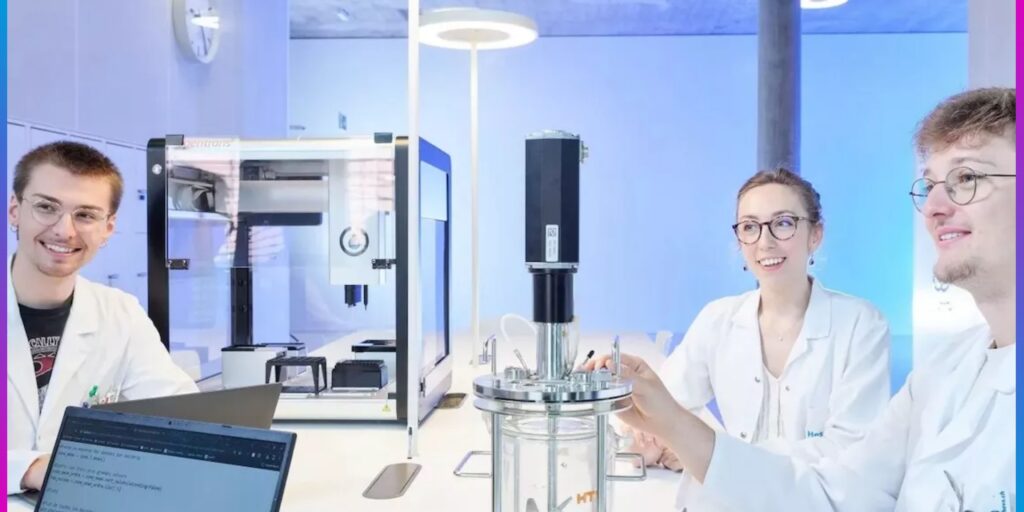
This is the gap the Digital Life Sciences specialisation at HES-SO Valais-Wallis is designed to address. The programme launched in autumn 2025 with ten students. It is not a computer science degree. It teaches digital methods applied specifically within life sciences disciplines, meaning students enter with grounding in classical fields and build digital competencies on top of that foundation.
The curriculum is structured progressively:
- Third-semester courses cover artificial intelligence, programming and algorithms
- The fourth semester moves into modelling, simulation and industrial process automation.
These topics are then developed further through industry projects in the final year.
Why this profile is becoming more relevant
In bioproduction, digital tools only create value when they are connected to the process.A model must help teams understand or improve a biological system. Data must support better decisions. Automation must improve robustness, reproducibility or scale-up.
A concrete example is AlphaFold: this AI system predicts protein structures within seconds, something that would otherwise require considerable time and resources in a laboratory. Applied correctly, that kind of capability changes how development and quality workflows are designed. Applied without scientific grounding, it produces outputs that teams cannot interpret or act on.
This is why the profile is changing. A biotech graduate may need to work with automated lab systems. A process engineer may need to interpret biological data. A data specialist may need enough life sciences literacy to contribute to quality, process optimisation or industrialisation.
Renzo Cicillini, site director at Lonza Viège, describes the need directly: this digital shift requires hybrid profiles with solid expertise in life sciences and advanced capabilities in digital technologies.
A clear need from industry
Alexandre Kuhn, head of the Digital Life Sciences specialisation, describes a clear need from companies for professionals who combine life sciences expertise with digital skills. That need is not theoretical. Life sciences companies are already working with more complex data flows, more automation, more modelling and more pressure to make development and production processes faster, more robust and more efficient.
Kuhn is direct on one point: technical skills alone are not enough. In practice, Digital Life Sciences graduates often play a central role within teams because they can move between biotechnological and digital contexts. The most useful profiles are those who can work across R&D, production, quality, engineering, IT and management, understanding enough of each environment to make collaboration more effective.
Birgit Sievert, head of the Life Sciences Engineering programme at HEI, frames the stakes directly: “This Digital Life Sciences specialisation aims to train talent ready to integrate into the country’s industries, because those industries operate in a highly competitive environment where digital innovation has become essential to sustaining top-level performance.”
A programme to look at closely
For students interested in life sciences, Digital Life Sciences offers a way to build a profile without choosing between biology and digital technologies. Not every graduate will become a data scientist. Not every biotechnologist will work in automation. But the ability to understand both the scientific system and the digital tools around it is a practical advantage in a sector where those two worlds no longer operate separately.
➡️ For anyone looking at future roles in biotech, bioproduction or applied life sciences, this is a training path worth exploring: Digital Life Sciences | HES-SO Valais-Wallis