

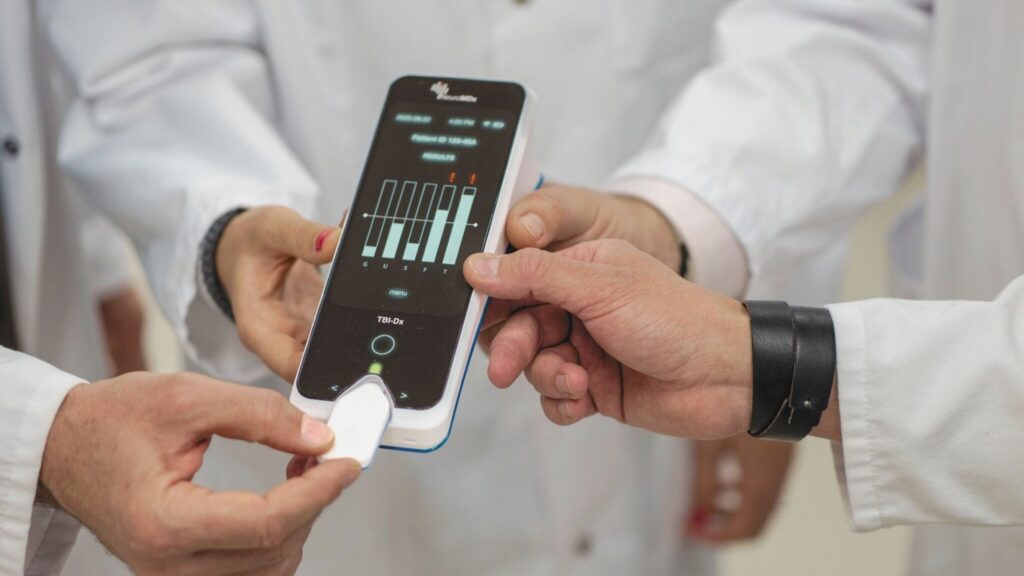
A recent publication in ACS Sensors presents a method to improve the sensitivity of diagnostic assays used to detect biomarkers in blood.
The work results from a collaboration between Deakin University (Australia), Université de Bordeaux (France) and the Institute of Life Sciences at HES-SO Valais-Wallis (Switzerland), involving in particular Prof. Paul Francis, Prof. Neso Sojic, and researchers including Pfeiffer, Milica Jovic, and Denis P.
Such biomarkers are critical for identifying acute conditions, including cardiac events or traumatic brain injuries, where early detection can directly influence clinical decisions.
Increasing signal without changing the test format
The study focuses on electrochemiluminescence-based immunoassays (ECLIA), known for their precision and compatibility with compact diagnostic systems.
The researchers introduced an additional reagent to amplify the luminescent signal generated during detection. This approach significantly increases signal intensity and improves sensitivity, particularly at low biomarker concentrations.
Importantly, the method remains compatible with existing assay formats, facilitating its integration into miniaturized diagnostic platforms.
Supporting faster and more portable diagnostics
Improving sensitivity is a key step toward enabling diagnostics outside traditional laboratory environments.
This type of development contributes to the emergence of portable, point-of-care devices that could be used in:
- emergency response settings (ambulances, helicopters)
- decentralized clinical environments
- on-site medical evaluation, including in sports contexts
It also supports multiplex approaches, allowing the simultaneous detection of several biomarkers within a single test.
A collaborative dynamic within the Life Sciences ecosystem
This work illustrates the role of international and interdisciplinary collaboration in advancing diagnostic technologies.
The involvement of the Institute of Life Sciences at HES-SO Valais-Wallis highlights the contribution of Swiss academic actors to the development of practical diagnostic solutions, at the intersection of chemistry, engineering and biomedical applications.
🔗Read the study : https://pubs.acs.org/doi/10.1021/acssensors.5c03895
🔗 More information: www.NeuroMDx.ch