

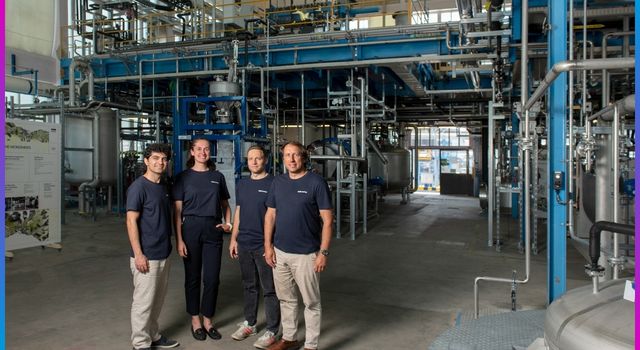
The cleantech startup DePoly has inaugurated its Showcase Plant at the CIMO industrial site in Monthey. With an annual processing capacity of around 500 tonnes of PET and polyester, the facility marks the company’s transition from pilot-scale development to industrial operation in Valais.
From research to industrial implementation
Founded in 2020 by Samantha Anderson, Bardiya Valizadeh and Christopher Ireland, DePoly develops a chemical recycling process for PET and polyester waste.
The company first tested and scaled its technology through a pilot plant. Construction of the Monthey facility began in 2024 at the CIMO site. At that stage, DePoly presented the plant as a blueprint for the development of larger commercial facilities.
The company was subsequently ranked first in the TOP 100 Swiss Startup Award 2024.
Recovering the original components of PET
DePoly’s process breaks PET and polyester down into their original monomers: purified terephthalic acid (PTA) and monoethylene glycol (MEG). These recovered materials can be used to manufacture new PET products with properties comparable to products made from fossil-based raw materials.
According to BioAlps’ report on the plant’s inauguration, the light-activated process operates in under 60 minutes without high temperatures or pressure. It can process waste streams that are difficult to handle through conventional mechanical recycling, including coloured packaging, polyester textiles, complex films and contaminated materials.
BioAlps also reports that the recovered PTA can have up to 75% lower emissions than conventionally produced PTA. This figure relates to DePoly’s process and should be assessed within the methodology and production conditions used by the company.
A 500-tonne industrial demonstrator
The Showcase Plant was inaugurated on 6 and 7 July 2026. It can process approximately 500 tonnes of PET and polyester feedstock per year.
Its construction required more than 10,000 hours of engineering work and involved over 100 companies and suppliers. The facility contains around 100 pieces of equipment, more than 1,100 instruments and valves, three kilometres of piping and 1.5 kilometres of electrical cables.
These figures make the industrial requirements behind scale-up visible. Moving from a laboratory process to continuous operation involves process engineering, equipment integration, infrastructure, supply-chain coordination and access to an appropriate industrial site.
CHF 50 million in signed customer volume
At the time of the inauguration, the Monthey plant had generated CHF 50 million in signed customer volume.
This commercial commitment provides an initial market signal for the treatment of PET and polyester waste streams that conventional recycling processes struggle to recover.
DePoly is already preparing a larger commercial plant with a target capacity of 50,000 tonnes per year. At the inauguration, the company indicated that the location was expected to be announced during the first half of 2027.
What the Monthey plant demonstrates
DePoly’s development provides a concrete example of an industrial scale-up pathway in Valais: research and pilot testing in Sion, followed by the construction of a demonstration facility at an established industrial site in Monthey.
The project also illustrates the conditions required to bring a process technology into operation. Scientific expertise remains central, but deployment depends equally on industrial infrastructure, engineering capacity, suppliers, partners and access to customers.
For companies evaluating where to scale process-based technologies in Switzerland, the Monthey plant offers a documented case of how these capabilities can be combined within the Valais industrial environment.